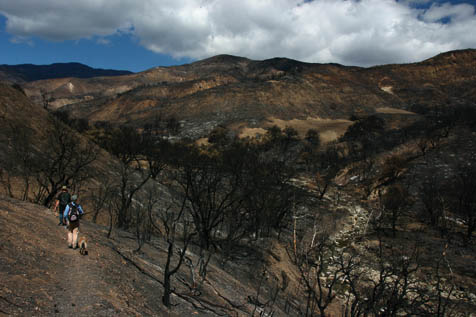
The Zaca Fire: 2007 Wilderness Wildfire and Watershed Impact
Description
Part A: Fire Metrics Fact Sheet
- Acreage: 240,207 acres
- Ignition: July 4, 2007; accidental sparks from a metal grinder during pipe repairs at La Laguna Ranch.
- Containment: September 4, 2007 (100% contained); October 28, 2007 (fully controlled).
- Structures Destroyed: 1 (U.S. Forest Service outpost); 1 helicopter lost in a non-fatal crash.
- Injuries/Fatalities: 1 documented civilian injury; 0 fatalities.
- Lead Agency: U.S. Forest Service / Santa Barbara County Fire Department / CAL FIRE.
Part B: Brief Summary
Igniting on Independence Day 2007, the Zaca Fire consumed more than 240,000 acres of the Los Padres National Forest, becoming one of the largest and most expensive wildfires in California's history at that time. While the fire remained largely within uninhabited wilderness, it caused massive ecological damage and necessitated a $117 million suppression effort. The incident is historically significant for its long-term impact on regional water security and the subsequent multi-million dollar legal settlement involving the responsible ranching entities.
Part C: Detailed Summary
The fire began in the Santa Ynez Mountains when maintenance work on a water pipe at La Laguna Ranch generated sparks that landed in brittle vegetation. Driven by a massive accumulation of chaparral that had not experienced a burn in decades, the flames rapidly ascended Zaca Ridge. Extreme fuel loads caused the fire to behave unpredictably, frequently spotting across lines and making ground-based attacks exceptionally dangerous. The blaze eventually penetrated deep into the San Rafael and Dick Smith wilderness areas, where rugged topography and a lack of road access forced a primary reliance on aerial firefighting assets.
Commanders prioritized keeping the fire from moving south toward the populated corridors of Santa Barbara and Ventura. Although the perimeter eventually stretched over 100 miles, structural losses were remarkably low, confined to a single backcountry outpost and a helicopter that crashed during operations at Figueroa Mountain. Suppression efforts lasted through the heat of the summer, with full containment achieved in early September, though the interior continued to burn until late October.
The fire’s most enduring legacy was the degradation of the Santa Cruz, Mono, and Indian Creek watersheds. A Burned Area Emergency Response (BAER) assessment revealed that over 50% of the Santa Cruz drainage suffered moderate to severe soil damage. Hydrologists warned that the loss of stabilizing vegetation could increase sediment runoff from two tons to 75 tons per acre, threatening to silt in the Gibraltar Reservoir and Lake Cachuma. These reservoirs are vital to the South Coast’s water supply, and the post-fire erosion created a years-long risk of debris flows and reduced storage capacity.
In 2011, the U.S. Department of Justice resolved a significant cost-recovery investigation regarding the fire's origin. Four companies associated with La Laguna Ranch, including La Laguna Cattle Company, LLC, agreed to pay $17 million to state and federal agencies. The settlement, which included $14 million for the U.S. Forest Service and $3 million for CAL FIRE, was intended to reimburse taxpayers for the historic suppression costs without a formal admission of liability by the corporate entities.
Media (1)
Sources (5)
People Linked (5)
📋 Why This Entry Is Included
Found an error or have additional information?
Help us maintain accuracy by submitting a challenge to this entry.
🚩 Challenge This Entry💡 Submit a Tip
Have information about this entry? Share it with our curators.